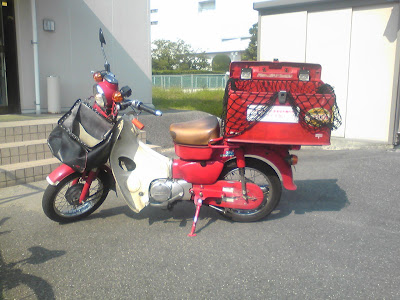
If you live in Japan, your Christmas packages might have been delivered by this type of Japan Post delivery motorcycle. These are the standard delivery vehicles for mail and small packages, thousands of which crisscross the country daily.
I spotted this Japan Post Honda Cub outside EPIC, the Ehime Prefectural International Center, idling where the driver left it to go inside for a delivery.
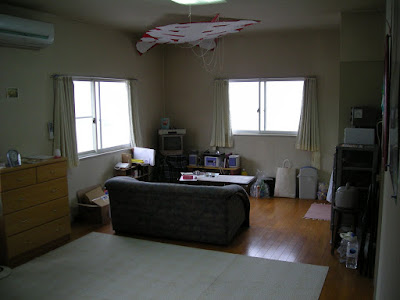
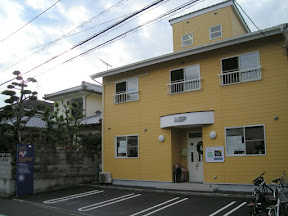
This is my old apartment in Kuwabara. It’s owned by ALS Matsuyama, my former employer, so when I left the company IÂ had to move out.
It’s not a bad place, cozy-small, but the kitchenette was hard to work with sometimes. There was only one electric burner, built into the counter next to a sink smaller than most bar sinks, and the fridge and microwave were both dorm-sized.
I salvaged an unused plastic filing cabinet from work to use as a makeshift pantry because there simply wasn’t any suitable space otherwise.
The apartment was definitely built for a single person to live in, though at one point I had a 30-something couple and their infant living next door. I always wondered (a, how they kept the kid quiet at all times and b,) how they managed to keep from killing each other in such a small space. Maybe that’s why they moved out.
If you look closely, you can see four of my five bins for sorting refuse. If you look REALLY closely, you can see that the stereo has a front-loading slot for MiniDiscs.
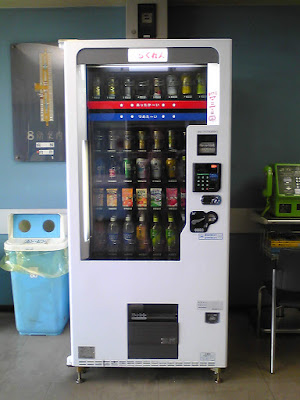
Japan has hot drink vending machines (think cans of hot coffee), which is neat but unsurprising at this point. I think this is the only dual-temperature vending machine I’ve spotted so far, though.
The drinks above the red line are hot, and the drinks below the blue line are cold. In the winter here, you can easily find hot tea in plastic bottles, as well as the aforementioned hot canned coffee.
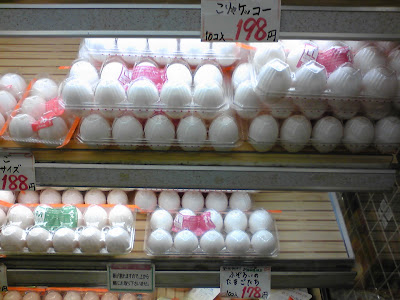
I took this picture at a small neighborhood market near my apartment.
In Japan, eggs aren’t sold by the dozen, they’re sold in packs of ten.
They’re sometimes even sold in packs of four, though mainly at convenience stores. Also at many convenience stores, you can buy just one hard-boiled egg.
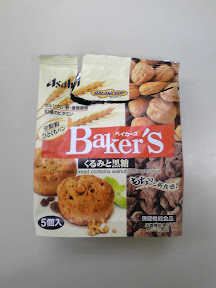
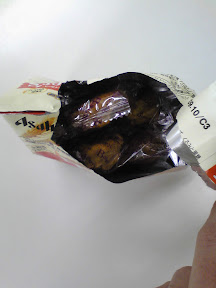
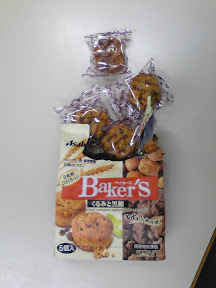
Japan is obsessed with individualized packaging. Case in point: I bought this bag of cookies without reading it too carefully expecting… I don’t know, a bag full of cookies, right?
When I opened it though, I found exactly FIVE cookies, each individually wrapped in its own little clear plastic bag. It’s the same story with most foods here though, so I can’t be too surprised.
I’ve seen party bags of snacks, segmented into handful-size plastic bags of snack mix. I’ve even (coincidentally) bought packages of sembei, those delicious Japanese rice crackers, with each cracker individually wrapped. And don’t get me started on bakeries that put each item on a piece of plastic, then wrap that whole thing in a small plastic bag, then put that bag in a large plastic shopping bag for you.
For a country that prides itself on being ecologically minded, there sure is a lot of excessive packaging.
I know I’ve been a bit of an absent blogger lately. Work’s been kicking my butt, and I’m one of those people who falls into the “if I can’t do it perfectly, then I won’t do it at all” trap sometimes. So to combat that tendency a little bit, I’m going to throw up some information in what I know is a less-than-ideal format. That said, here’s what I’ve been up to recently:
I moved in with Yuko a few months ago. Her parents weren’t thrilled with the idea at first, but they’ve since come around, which brings me to my next point:
I met Yuko’s parents yesterday. They were supposed to come out to Matsuyama around Christmas, but her dad hurt his back. They brought a carload of stuff, including enough food to feed a small militia for a few days. Luckily, Yuko is a fantastic cook, and the veggies her mom brought are all really fresh.
I applied to JET for the 2009-2010 school year, and had to go to Guam in February to interview. This created a tricky timing problem. I had to tell American Language School in April if I was going to renew my contract (set to expire in July), but JET notifies participants through May (and sometimes later) if they’re hired for positions starting in August. I ended up not renewing with ALS but not getting a JET position either, which leads to my next point:
I started working for a different English school here in Matsuyama. I now work for Miki Study Pals (pictured at left), a school that caters to parents who can pay for their kids to become essentially bilingual. Even though the bilingual students only represent about 10% of the students at the school, they have a bit of a “halo effect”, much like the Toyota Prius makes people associate fuel economy with Toyota.
I mentioned that work has been kicking my ass. I’ve been tasked with designing the curriculum for the last three months of the school year (January – March) for one of my co-teaching classes, and decided to go with a music unit. So I’ve been reading a lot of lesson plans, worksheets, and exercises that teachers have put out there on the web, trying to figure out what I wanted to do with the kids, who are all around ten years old, and mostly bilingual. Then I had to wrap my head around the best way to organize and present the material. My first lesson was Saturday, and it went quite well. =)
I think that’s all of the major stuff. I’ve done some traveling with Yuko recently that I should blog about. And I keep taking photographs of weird stuff with the ultimate goal of putting them up here. I’m sure I’ll figure out a way.
While walking to the grocery store a couple days ago, Yuko and I stumbled across a secondhand video game store named ã‚ャンプ (Camp). Yuko was super-interested, and wouldn’t walk away without at least browsing to see what classic titles they had.
Oh wait, that was me. 🙂
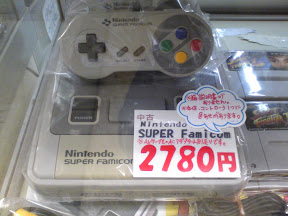
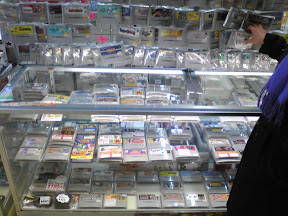
They had a bunch of stuff you’d expect, and a few surprises. Here’s a Japanese Super Famicom, brother of the Super Nintendo many of us know and love. It’s in the lower left of the case full of games, as you can see. Oh, and please excuse the image quality here, as all I had was my phone.
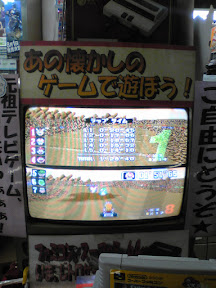
No Super Nintendo display would be complete without Super Mario Kart, so they had a unit running. Yuko and I played a couple of races, and what really struck me was how primitive it looked. For a seventeen year old game though, it’s still pretty solid.
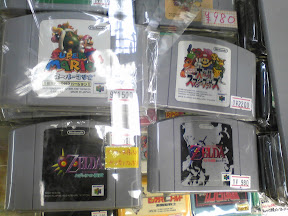
They also had Nintendo 64 games. I wanted to snap a pic of the Japanese labels because it’s odd seeing something with which you’re very familiar changed just a little. Imagine if you went back to the house where you grew up and your bedroom door opened out, instead of in. Wouldn’t you take a picture of that? Also, I thought it was a travesty that Smash Brothers was more than twice the price of Ocarina of Time.
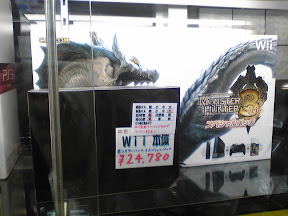
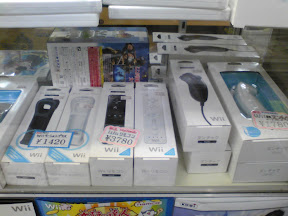
In Japan, you can buy a black Wii, and associated peripherals. For the life of me, I can’t figure out why they don’t sell it in America. I’m sure it would sell well. Anyway, here’s a black Wii bundled with Monster Hunter 3 and the Classic Controller Pro, also not sold in America. Also, a snap of some used black peripherals.
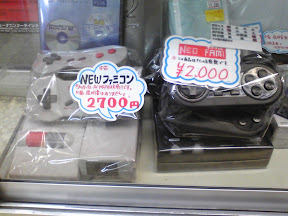
Rounding out my trip down memory lane was this pair of NES machines (that would be the original Nintendo Entertainment System, for the uninitiated). On the left is Nintendo’s reissue of the original NES machine, and on the right is a recent knockoff of the console. I imagine the “original” machine is more expensive because they’re harder to come by. Anyway, if anyone really wants any of this stuff or other Japanese gaming stuff, let me know, as I pass this shop going to and from work every day. 🙂
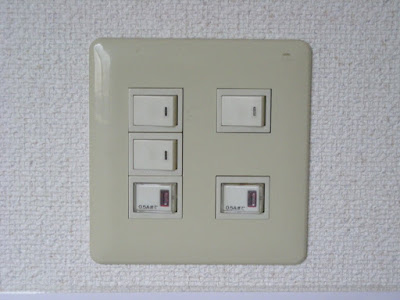
Pictured on the left is a wall plate of five Japanese light switches. They’re always mounted to switch horizontally (as opposed to vertically in the US). The little oval mark is the “on” position, which always seems to be on the right. The bottom two switches are for vent fans (I took this picture in a commercial kitchen), which when switched on, are backlit by a red light.
Also interesting is that most switches are outside of the room they’re switching, so you have to turn the light on before you enter a room, or you’ll have to go back out if you forget.
As you may or may not know, I’m a rather independent person. Much to my mother’s chagrin, I used to take lots of things apart when I was young, just so I could see how they worked and put them back together. I like not having to rely on other people’s help to fix things, or get stuff done, you know?
In fact, part of my motivation for coming to Japan was that it would force me out of my comfort zone- because I knew I wouldn’t understand Japanese life, I knew I would be “off balance” and have to figure many things out anew. When I first arrived, I quickly discovered that you can’t have pride if you don’t understand your surroundings; you need to be willing to ask for help and rely on the kindness of strangers.
After living here for almost a year and a half though, you get into the routine of daily life, and it’s easy to forget the helplessness that was at first a daily experience.
Anyway, I recently completed the registration process for a GoLloyd’s account. It’s commonly recognized as the cheapest way to send money home, but I’d put off the signup process for a long time because it involves mailing copies of your passport and alien registration card to their headquarters in Tokyo with your application form. With the welcome packet, I received general instructions on how to transfer money using GoLloyd’s, and some pertinent terms in Japanese. Armed with their instructions and list of kanji, I went to my local bank to use an ATM to send some money, and quickly realized I was in over my head.
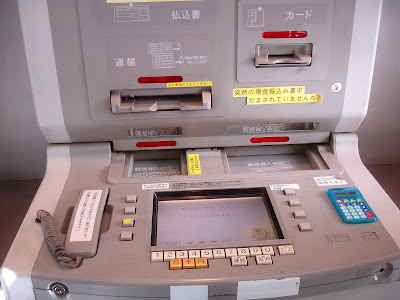
Japanese ATMs are wondrous pieces of machinery (one of which is pictured above), allowing you to complete all manner of transactions, including the inter-bank transfer I needed to do. Unfortunately, only a few ATMs have English menus, and only for basic functions. I fuddled my way around the menu system for a few minutes and got about halfway through the process while a bank employee stood about eight feet behind me, waiting to see if I needed help. I eventually gave up and tried to ask her, but ended up at a teller window after a brief wait in line. The teller then walked me back to the lobby attendant and asked her to help me do the transfer using the ATM. All semblance of self-reliance now gone, she read in Japanese from the help page GoLloyd’s sent (thank goodness they included Japanese instructions- written specifically to Japanese bank staff to help confused gaijin) and walked me through the process. I tried to follow along, but there were too many menus in kanji I didn’t understand, and knew I wouldn’t be able to repeat the process.
I’d heard that getting a separate ATM card specifically for transfers simplifies the process, so after the transfer was done, I asked her about getting one (so I could hopefully be self-reliant in the future). She kindly walked me back to the ATM and showed me that my ATM card stored the transfer settings for future use, making it even simpler than having a separate card for transfers. I thanked her profusely and left the bank.
I’m starting a new series of posts on my blog today. It’s basically just a quick blurb about something unexpectedly different between America and Japan. So, without further ado, here’s “It’s the Little Things,” part the first.
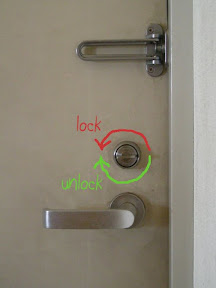
99% of the time (anecdotally, of course) locks in Japan lock with what I’d call “underhand” rotation, meaning that the lower part of the lock matches the movement of the bolt- as opposed to American locks, where the movement of the bolt typically mirrors the movement of the upper part of the lock.

 If you live in Japan, your Christmas packages might have been delivered by this type of Japan Post delivery motorcycle. These are the standard delivery vehicles for mail and small packages, thousands of which crisscross the country daily.