Archive for the “Japan” Category

Even Parmesan cheese needs a mascot and a cell phone strap in Japan.

Comments No Comments »

When I tell people that I’m officiating weddings on the weekend, a question I’ve been asked a number of times is “Why do Japanese people like ‘Western-style’ weddings?”

The biggest reason is “Because it’s cool,” but if you’re interested in reading more about it, I just happened onto the seiyaku.com web site, which does a fabulous job explaining it:

http://www.seiyaku.com/seiyaku/en/western-wedding.html

Their description is pretty accurate for the ceremonies I perform, too- which makes sense, because Japanese people like to do things the same way everyone else does.

Comments No Comments »

It’s been an interesting day. I woke up super early this morning (5am is super early for me now) to go see this year’s fighting mikoshi festival at Dogo. I didn’t bring my real camera because I didn’t want it to get rained on, so I’m glad I got decent photos and video last year. The pics snapped with my phone camera are pretty useless, but Kevin got a decent video or two.

It’s been raining for the last three days, actually. It started out as a nice steady light rain, but just in the last few hours it’s gotten heavier. At this point though, the rain isn’t as big a deal as the wind, which almost inverted my umbrella as I was riding to work. You see folks, Typhoon 18 is about to hit southern Japan.

I hear about typhoons pretty regularly, but I don’t usually pay attention to the warnings because the east-west mountain range just south of the city usually diffuses any strong weather before it hits Matsuyama. (Unless of course, I’m riding a bicycle across a series of bridges that day. Then it will undoubtedly rain cats and dogs.)

This time is a little different though. I actually have a typhoon warning on my phone, evening classes at my school were canceled (which I didn’t learn until I had already pedaled over there), and the business next door to my apartment building piled sandbags in front of their door.

I think we’re in for some real weather here.

If I don’t post again, look for me in Oz.

******** Update October 9th, 2009 ********

Much ado about nothing down here in Matsuyama. It hardly rained that night, and the next day was beautiful. The city of Tsuchiura, in Ibaraki prefecture however, was not so lucky:

Comments 2 Comments »

Yesterday, Yuko and I took a one day trip to see Himeji castle near Kobe. We chose Silver Week to do so because I don’t have many consecutive days off right now at my new job, so the five day break (four for me…) seemed an obvious time to travel. Also, they’re going to be doing five years’ worth of restoration starting next month, so I figured I should get on it before they put up the scaffolding. Silver Week happens sporadically (once every five to ten years-ish) when national holidays and the stars align (not kidding- one of the holidays is the autumnal equinox). The name comes from the desire of Japanese commercial interests to capitalize on the entertainment money spent during Golden Week every April.

Our trip was originally going to be a two day trip, but as every hotel Yuko called was completely booked (including capsule hotels, though I later discovered she hadn’t tried any love hotels), we shortened it to one day. Almost exactly twenty four hours in fact, as we caught the highway bus at 6:00am on Monday, and returned on the overnight bus at 5:52am this morning.

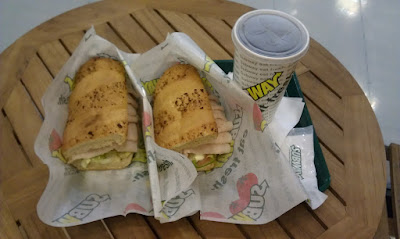
Anyway, it was pretty sweet. We arrived in Kobe at about 10am, and went straight to Himeji castle. One of the highlights of the trip for me was eating lunch at Subway before going to the castle. Matsuyama doesn’t have any sandwich shops, and I really miss being able to get a sub sometimes.

Never underestimate Japanese people’s ability to spontaneously form a line. I guess the throng that showed up because of the national holiday was a lot more than normal, so they had to control the number of people inside the castle at once. As visitors entered the grounds from the main gate, they sort of spontaneously started congealing and slowing down to form a line. Being American, I insisted on seeing what the front of the line was up to before joining the back end of it, a trip that satisfied my curiosity but cost us about 15 spaces in line.

I don’t know many Japanese ghost stories, but one that I’d heard before coming to Japan was of the servant girl Okiku who was betrayed, murdered, and thrown down a well. I was pleasantly surprised to find Okiku’s well on the grounds of Himeji Castle.

Even once we were inside the castle grounds, the large number of people visiting the castle on the same day created a remarkably long line to actually get inside the castle building. They set it up very much like a Disneyland ride line, where you go through one waiting area thinking that you’re almost to the front, only to turn the corner and find that there’s another area full of people waiting.

The castle itself provided a commanding view of the city surrounding it, of course.

Many of the walls inside had hooks for weapons and gunpowder bags.

I found the architecture really neat. It takes huge wooden beams to support a six story castle, and they were definitely in evidence. I was a little surprised to learn that the current form of Himeji had never been used in a war, so all of the intricate battlements constructed remain essentially untested.

After the castle, we went to Koko-en garden just outside the main gate. They have nine different styles of Japanese gardens on the grounds, which I would have given a pass, but Yuko was interested. The gardens were very serene and beautiful, to be sure, and they had some landscape art installations that were interesting. It was near the end of a very long day though, and I was tired from all the walking we’d done, so it was hard for me to be as appreciative as I might otherwise have been.

No trip to Kobe would be complete without a steak dinner, so we stopped by “ステーキランド”, the very appropriately named “Steak Land” restaurant near Sannomiya station. We both ordered one of the less-expensive dinner sets, but let me tell you, it was easily the best steak I have ever had. They cook on teppan grills in front of the customer (think Benihana) using only the most basic of ingredients: meat, salt, pepper, butter, and oil. The steaks there come with two light dipping sauces, adding a subtle flavor of garlic or soy sauce, but the steak easily stood by itself. My steak was so tender that when I poked it with one of my chopsticks, it cut a little circular hole through the surface of the steak, but the meat still had a very pleasing texture in the mouth. Absolutely exquisite, I tell you. While we were eating, another couple at the same table ordered shrimp, and it was so fresh that it was actually alive as the chef put it on the grill, its little legs moving around, huffing for its last few breaths of suffocating air.

After dinner, we spent our last few hours in Kobe on the boardwalk called Harbor Land (“ハーバーランド”). It was a surprisingly American affair, with an open-air mall atop a parking garage and restaurants, replete with fair-type attractions like a ferris wheel, kiddie rides, crane games, and a playground. One interesting attraction held two “3-D” roller coaster magic motion pods. The experience was 3-D by way of a helmet covering the user’s eyes with two small screens filmed from two video cameras in the front seat of a few famous rides, including the Desperado at Buffalo Bill’s. After riding, I can tell you that it’s fun, but not nearly as exciting as the real thing. It’s kind of like a roller coaster for people afraid of roller coasters, but the experience was worth the $3. We also took our requisite ferris wheel ride and ate dessert at a small cafe with a view of the Kobe tower, overlooking the water. After that, we killed our last half hour or so by leisurely window shopping our way through the closed mall.

Closing out our very long day, we caught the midnight bus back to Matsuyama, arriving just as the city was starting to wake up.

Last up is a picture from my seat in the overnight bus, showing that they only have three seats across, with two aisles (and free coffee and tea). The seats recline pretty steeply, and leg and foot rests extend from the seats as well, so it’s easy to relax. Think about that next time you’re sitting in economy class wondering if there isn’t a more comfortable way to travel.

I leave you with a slideshow of most of my better pictures from the trip. Though if you’re reading my blog on Facebook, you won’t be able to see it. Try this link: http://www.davidhed.com/blog/

http://en.wikipedia.org/wiki/Silver_Week

Comments 2 Comments »

No open container laws.

In the left cup holder is an open Asahi beer, and in the right is an open bottle of tea. In all fairness though, Japanese people do not mess around with alcohol and driving a car. There’s none of that “I’ve only had a couple, I’m okay to drive” thinking that you sometimes find in the states. If you’ve had alcohol, you don’t drive.

Comments No Comments »

Pictured on the left is a wall plate of five Japanese light switches. They’re always mounted to switch horizontally (as opposed to vertically in the US). The little oval mark is the “on” position, which always seems to be on the right. The bottom two switches are for vent fans (I took this picture in a commercial kitchen), which when switched on, are backlit by a red light.

Also interesting is that most switches are outside of the room they’re switching, so you have to turn the light on before you enter a room, or you’ll have to go back out if you forget.

Comments 2 Comments »

I just had a humbling experience at the bank.

As you may or may not know, I’m a rather independent person. Much to my mother’s chagrin, I used to take lots of things apart when I was young, just so I could see how they worked and put them back together. I like not having to rely on other people’s help to fix things, or get stuff done, you know?

In fact, part of my motivation for coming to Japan was that it would force me out of my comfort zone- because I knew I wouldn’t understand Japanese life, I knew I would be “off balance” and have to figure many things out anew. When I first arrived, I quickly discovered that you can’t have pride if you don’t understand your surroundings; you need to be willing to ask for help and rely on the kindness of strangers.

After living here for almost a year and a half though, you get into the routine of daily life, and it’s easy to forget the helplessness that was at first a daily experience.

Anyway, I recently completed the registration process for a GoLloyd’s account. It’s commonly recognized as the cheapest way to send money home, but I’d put off the signup process for a long time because it involves mailing copies of your passport and alien registration card to their headquarters in Tokyo with your application form. With the welcome packet, I received general instructions on how to transfer money using GoLloyd’s, and some pertinent terms in Japanese. Armed with their instructions and list of kanji, I went to my local bank to use an ATM to send some money, and quickly realized I was in over my head.

Japanese ATMs are wondrous pieces of machinery (one of which is pictured above), allowing you to complete all manner of transactions, including the inter-bank transfer I needed to do. Unfortunately, only a few ATMs have English menus, and only for basic functions. I fuddled my way around the menu system for a few minutes and got about halfway through the process while a bank employee stood about eight feet behind me, waiting to see if I needed help. I eventually gave up and tried to ask her, but ended up at a teller window after a brief wait in line. The teller then walked me back to the lobby attendant and asked her to help me do the transfer using the ATM. All semblance of self-reliance now gone, she read in Japanese from the help page GoLloyd’s sent (thank goodness they included Japanese instructions- written specifically to Japanese bank staff to help confused gaijin) and walked me through the process. I tried to follow along, but there were too many menus in kanji I didn’t understand, and knew I wouldn’t be able to repeat the process.

I’d heard that getting a separate ATM card specifically for transfers simplifies the process, so after the transfer was done, I asked her about getting one (so I could hopefully be self-reliant in the future). She kindly walked me back to the ATM and showed me that my ATM card stored the transfer settings for future use, making it even simpler than having a separate card for transfers. I thanked her profusely and left the bank.

Comments No Comments »

In Japan, patrons get a little plastic basket to hold movie concession items. At the end of the movie, employees stand outside each auditorium to collect the baskets (now containing each patron’s refuse).

Also possibly related- Japanese theater floors are not sticky.


Basket pictured in front of a Terminator 4 (ターミネーター4) poster

Comments 1 Comment »

I’m starting a new series of posts on my blog today. It’s basically just a quick blurb about something unexpectedly different between America and Japan. So, without further ado, here’s “It’s the Little Things,” part the first.

Pheer my mad Photoshop skillz 99% of the time (anecdotally, of course) locks in Japan lock with what I’d call “underhand” rotation, meaning that the lower part of the lock matches the movement of the bolt- as opposed to American locks, where the movement of the bolt typically mirrors the movement of the upper part of the lock.

Pictured is my apartment door, currently locked.

Comments 1 Comment »

I’m going for a ride on the Shimanami Kaido bridges again tomorrow, so I figured I should at least post about my last trip first, to avoid any confusion. Serena, May, and I rode northbound from Imabari (Sunrise Itoyama, specifically) in the middle of Typhoon #6 a few months ago. (Japan numbers their large meteorological events instead of naming them. I guess it’s to keep them at arm’s length in case they don’t call in the morning.)

Sunrise Itoyama is a bicycle rental place in northern Imabari, very close to the start of the bridge system spanning the Seto Inland Sea. (I rented a bicycle instead of trying to ride my craptastic mama-chari one speed Japanese clunker of a city bike across sixty kilometers of sparsely populated islands and bridges.) It’s a beautiful ride, with bridges hopping across a series of islands that peek like giant stepping stones out of the water.

The weather forecast for the day said that the typhoon might be right where we were, but we were hoping it would just graze us. Regardless of the weather, we couldn’t change the details of the ride, as it had been organized as part of Bicycle for Everyone’s Earth (BEE), a group here in Japan that promotes environmentally conscious living through eco-friendly education and consumption. Each year they organize a two-month, 3000 kilometer ride from Japan’s northernmost island of Hokkaido to the southernmost island of Kyushu, and the three of us joined them for the day they planned to ride north across the Seto Inland Sea.

So we all brought our rain gear, and it’s a good thing we did. It was just lightly sprinkling rain when we set out, but by the time we made it onto the first bridge, we were in the middle of a deluge. We turned around when we didn’t see the BEE team in the first bridge, as the rain just kept getting heavier and heavier. By the time we got back ten minutes after starting out, the water was deep enough on the street in front of the bike rental place that you couldn’t pedal- the water was above the pedals’ lowest point.

When we got back inside, we found the BEE team regrouping; they had set off just after us and come back just before us, and were already hard at work drying off their clothes. We talked to them about their travels while waiting for the rain to slack off a bit then and set back out on our grand adventure.

The day quickly turned into a series of fiascoes, though. The BEE team suffered through a number of flat tires, two broken spokes, and a broken rear pannier rack, and eventually told us three interlopers to go on ahead of them. That was the last we ever saw of the team…

We got a late start and were riding slow because of the rain, and as a result May was running short on time and had to bail in Omishima, just shy of the halfway point. Serena and I pressed on, actually making a wrong turn at one point that ended up being a “shortcut” through a rural area instead of following the major highway on the other side of the island.

It rained on and off the whole day, but luckily it was never as heavy as it was in the first ten minutes. It also got dark surprisingly quickly. Fortunately, a couple of the bridges had separate, well-lit decks for bicycles. It was totally dark by the time we arrived in Omishima, which was an unanticipated problem. The rental place had ostensibly closed an hour before we arrived, but there was still an old man sitting in a shack on their lot, whom we convinced to take out bikes off our hands. Then we had to figure out how to get back to Matsuyama. “The guy” at Sunrise Itoyama said there was a late southbound bus back across the bridge system, but it wasn’t running that Sunday. By the time we realized the late bus didn’t exist, the last actual bus had, in fact, just left the bus depot.

One of the waiting bus drivers took pity on our plight once we managed to explain it, and he got a waiting taxi driver to take us through some super-secret door on the highway overpass to a pickup point just ahead of that last bus we needed, where he personally waited with us and made sure we got on the bus. I tell you, between learning that the depot had no more buses home, figuring out how to get help in Japanese, and waiting for the bus on the bridge, that was a seriously stressful hour or so, and I am still amazed at the generosity of the Japanese people.

The bus ride back to Imabari was uneventful, Serena and I just unwinding from the day. Then it was an easy train ride back into Matsuyama and blissful recuperative sleep.

Wow! Now I’m ready to go do it again! :-D

Comments 3 Comments »