Archive for the “work” Category

Today was an interesting day. I’m teaching summer camp right now, and today was the first outing for one of the office ladies to go out with a class on a field trip. She was incredibly nervous- so much so, in fact, that she worked herself up into a literal fever this morning before we left.

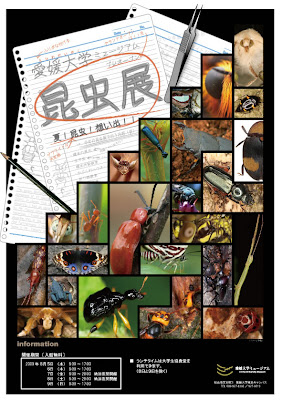
We went to Ehime University’s annual insect exhibition, and it went really well, even though the end of the field trip found me running to get to the bus so we could get back to school on time. The museum had a “Quiz Rally” that the kids found exciting, involving a quiz station set up in each exhibit room where the kids had to write their answers on an answer sheet to win a prize at the end. The prizes ended up being postcards from the gift shop, but they were colorful closeup photos of exotic insects, at least.

The problem was they didn’t have any signage about where to take the answer sheets when you were done, and we were already short on time, so I sent the kids (only five) ahead to the bus with my de facto assistant while I ran around the museum trying to figure out where to get the kids’ “prizes.”

All’s well that ends well, I suppose.

Comments No Comments »

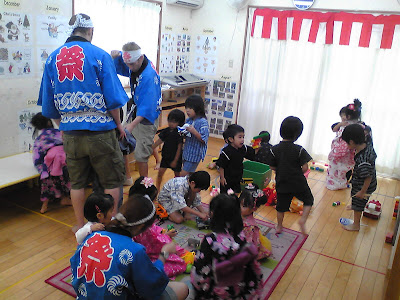
My school had its annual “Summer Festival” on Sunday.

We had a variety of games and booths set up in the classrooms, including a fishing game, a dice game, shaved ice, and my paper airplane booth.

It was pretty neat seeing the kids dressed up in all their summer livery- all these little yukata and jinbei running around made me want my own, so Yuko and I went to Jusco and bought a jinbei for me yesterday. =)

Comments No Comments »

At MSP, a lot of what we do is teach kids activity-focused language to enable them to talk about their lives and the things they do in English, but we’re still essentially a school for learning English.
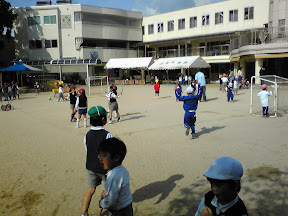
Japanese kindergartens (yochien) are very different than American kindergartens. For one (as far as I can tell), they’re separate institutions of learning, not attached to elementary schools. Also, the large classes don’t seem to be tightly organized. The kids are much freer to do as they please as opposed to older Japanese schoolchildren.

The theory is that the kids have to be free to find their role in the group, then push themselves to fit into it, rather than having an authoritarian teacher or school administrator (or parent) push you into following the rules. As a teacher, I’ll certainly grant that allowing kids to self-correct is often more effective than correcting them yourself whenever they make a mistake.

Anyway, in order to give our students the best of both worlds (the yochien-style “Lord of the Flies” experience as well as the small class size and personal attention we offer at MSP), we take some of our students on field trips to a local kindergarten about once a month.
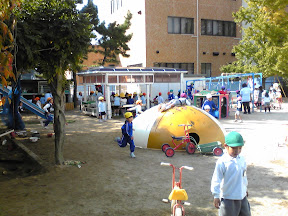
My first time there was absolutely terrifying. I didn’t really know anything about Japanese kindergartens, and I was expecting row upon row of cute little smiling faces greeting the group of visiting kids, which I would enthrall with my English-teaching skillz. That was the plan, anyway.

We always show up at recess, when the entire student body is free to do whatever they please. They literally have free rein inside the school’s fence, with some kids running around inside the various classrooms gluing milk cartons and cardboard together, but most of the kids outside, doing educational things like using real knives to cut up real vegetables and put in real frying pans on real gas burners (no gas, of course, that wouldn’t be safe). Or jumping on top of a two meter tall jungle gym. Or practicing their unicycle skills (I kid you not).
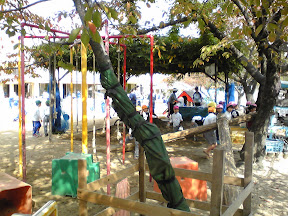
Immediately after we arrive, we put our stuff down in the classroom where we’ll be teaching, and head back outside to make some friends.

Playing with the kids is actually pretty cool. Once you realize that nothing either of you says is intelligible to the other, communication becomes all gesticulation and body language. But really, you’re not engaging in intellectual discourse, you’re a walking novelty on a kindergarten playground, so it’s fine.

After recess is over, it’s showtime. This is when the MSP teachers give a thirty-minute lesson to the kindergarten kids. As I think back, I believe there are about 30-35 kids in a classroom, and I always disperse the MSP kids throughout the room. They make good plants, so there are always at least a few voices answering your questions. ;-)

We’ve done lessons for Halloween, Christmas (there’s a whole other topic), animals, and most recently, things in the room. My lessons usually involve the kids smiling and shouting at the top of their lungs, then (sort of) singing a song involving the vocab they just heard, and maybe a little pointing or item identification game or something. Good times.

What prompted me to write this already-too-long-for-itself entry is the field trip we took last week. It was the first time I felt really comfortable wading into the sea of black-haired ankle-biters. I knew the drill, I knew where we needed to go and when, I seemed like I finally looked like a figure of authority for these kids I’d never seen before.
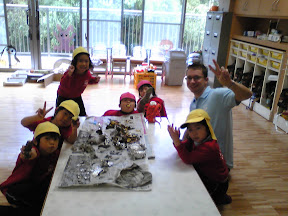
After recess, we had our lesson, and the kids all responded fantastically. They paid attention, they repeated, they pointed, and they shouted on cue. After the lesson, four separate kids came up to me to ask me to sit at their lunch table.

After eating, I sat down on the tatami mat by the bookcase and talked to the small-but-growing group of kids about what I saw in their Japanese books. They pointed at stuff and said things in Japanese. I picked up what I could, but their Japanese was still better than mine, so I mostly ended up smiling, nodding, and saying the thing in English (which is what they wanted most of the time, anyway).

I feel like I’m finally getting the hang of this. :-)

<a href=”http://picasaweb.google.com/lh/photo/VcpKxc-wP-jisqhN8EDLNA?feat=embedwebsite”><img src=”http://lh5.ggpht.com/_tPVAWD6nVDQ/S_Xz84OUBfI/AAAAAAAAEQ4/h37VdKy6YFU/s288/SBSH0240.JPG” /></a>
Comments 3 Comments »

The school year in Japan runs on three semesters, roughly April-July, August-December, and January-March. Kids get a vacation in between each semester: as little as two weeks, up to a month for some schools in summer.

Between the last semester of the year and new year starting in April, my school runs a two-week day camp for kids who want to keep their English skills polished (read: moms who don’t want their kids underfoot while they’re on vacation).

The kids seem to really enjoy it, as it’s a low-pressure environment, but the planning is pretty stressful for the teachers, because it’s basically a one-off for planning purposes. This frees your hand when planning, but it doesn’t give you any real direction, and lesson planning without any goals or direction is not easy.

We have three camps at our school, and together with Joe (a new teacher as of a few months ago) I’ve been in charge of the oldest group of kids. It’s actually two one-week sessions back to back, with a few of the same kids enrolled in both weeks, so we couldn’t run the same plan twice. We decided to go with flowering plants for week one and birds for week two.

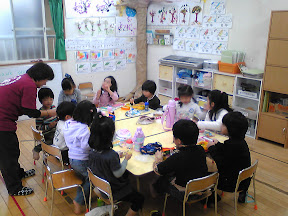
The picture is lunchtime with the kids and assistant in the classroom. In the background, you can see some of their artwork on the wall, and you can sort of see the tree in the corner on which we’re been hanging various birds made out of origami.

Between the camp and planning classes for next semester, I’m swamped.

Comments No Comments »

If you’ve known me for a while, you know that I can be a little… particular sometimes. I like clean things. I used to be a little obsessive about keeping my hands clean, but I’ve relaxed a lot over the last ten years or so.

A couple years ago, a friend told me that I’d relax my hygiene rules once I had a kid to take care of. You know, kids eat off the floor and stick their hands in the dirtiest… Anyway, Shannon Wood, this story is for you.

Friday afternoon, during a free play period for one of our younger classes (3-4 year olds), I was sitting on the floor between some girls playing with pots and dishes and a group of boys making “guns” out of plastic building blocks. Gender stereotypes aside, I was having fun playing with the kids, my participation going back and forth between the two groups.

This particular classroom has a restroom in the actual classroom, so I didn’t think too much of it when I caught a whiff of something that smelled like dirty diaper, especially because I was only a few feet from the door. As I was sitting there playing for a few minutes though, I was less and less convinced that the smell was coming from the restroom.

I asked the boy on my left if he needed to use the restroom, and he said it was the girl on my right, who also said she didn’t need to use the toilet. Slightly confused, I looked around a little more closely and discovered a small piece of poo on the floor near me about the size of a sunflower seed.

I grabbed a tissue, quickly picked it up, and asked my assistant if she knew what was up. She instantly knew which student it had come from, and took the girl I’d asked earlier into the restroom.

As it turns out, she’d messed her pants but continued playing, and it had worked its way out of her pants.

Hoping to keep the problem as contained as possible, I inspected that whole side of the classroom, but didn’t find any other untouched pieces. I did find one that had been rather effectively spread on the bottom of a plastic doctor kit next to where I was sitting. This disturbed me, because I was not interested in rolling around in some kid’s poo, whether it be on my clothing or skin.

Unfortunately, I wasn’t so lucky. I found a few strong smears along my outer left leg from when I’d been sitting with my legs crossed.

I don’t know exactly what words would describe how I felt. This was my first class of the day, and I had a parents’ observation in a few hours. But really, that was a secondary concern for me right after “I have poo stripes on my pants. I have freaking POO STRIPES on my PANTS.”

But I couldn’t just abandon my class, obviously. So I got out the hand sanitizer and cleaned up the floor as much as I could. I tried to put it out of my mind as much as I could. We had a drawing exercise we did after play time was over. And during a short break after that class, I went home as quickly as I could. (There’s one nice thing about riding a bicycle instead of driving a car- you can stand up to avoid getting poo on the seat should you need to do so.)

Disaster averted, I went back to school with clean pants.

My takeaway lesson is that I can handle the stuff like that that I know I’ll have to deal with around kids, be they mine or someone else’s.

But seriously? If you can avoid it, don’t sit in someone else’s poo.

Comments 1 Comment »

I know I’ve been a bit of an absent blogger lately. Work’s been kicking my butt, and I’m one of those people who falls into the “if I can’t do it perfectly, then I won’t do it at all” trap sometimes. So to combat that tendency a little bit, I’m going to throw up some information in what I know is a less-than-ideal format. That said, here’s what I’ve been up to recently:

  • I moved in with Yuko a few months ago. Her parents weren’t thrilled with the idea at first, but they’ve since come around, which brings me to my next point:
  • I met Yuko’s parents yesterday. They were supposed to come out to Matsuyama around Christmas, but her dad hurt his back. They brought a carload of stuff, including enough food to feed a small militia for a few days. Luckily, Yuko is a fantastic cook, and the veggies her mom brought are all really fresh.
  • I applied to JET for the 2009-2010 school year, and had to go to Guam in February to interview. This created a tricky timing problem. I had to tell American Language School in April if I was going to renew my contract (set to expire in July), but JET notifies participants through May (and sometimes later) if they’re hired for positions starting in August. I ended up not renewing with ALS but not getting a JET position either, which leads to my next point:
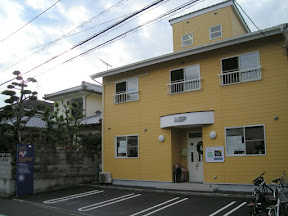
  • I started working for a different English school here in Matsuyama. I now work for Miki Study Pals (pictured at left), a school that caters to parents who can pay for their kids to become essentially bilingual. Even though the bilingual students only represent about 10% of the students at the school, they have a bit of a “halo effect”, much like the Toyota Prius makes people associate fuel economy with Toyota.
  • I mentioned that work has been kicking my ass. I’ve been tasked with designing the curriculum for the last three months of the school year (January – March) for one of my co-teaching classes, and decided to go with a music unit. So I’ve been reading a lot of lesson plans, worksheets, and exercises that teachers have put out there on the web, trying to figure out what I wanted to do with the kids, who are all around ten years old, and mostly bilingual. Then I had to wrap my head around the best way to organize and present the material. My first lesson was Saturday, and it went quite well. =)

I think that’s all of the major stuff. I’ve done some traveling with Yuko recently that I should blog about. And I keep taking photographs of weird stuff with the ultimate goal of putting them up here. I’m sure I’ll figure out a way.

Comments 3 Comments »

I had a kid visit class today that really scared me. Not in a “trenchcoat mafia” kind of way, but in a “holy crap, your existence shakes the core of what I know about how to do my job” kind of way.

For the first time since I moved to Japan, I met a bilingual Japanese kid.

He’s six years old, and his English speaking ability is arguably better than my office manager’s (listening unarguably so). He goes to a special school that’s taught all in English, a school which Ms. Semba says “only very rich families can pay for.” He and his classmates are only allowed to speak English while at school, so speaking English is (literally) second nature to him. Neither of his parents speak it fluently, though his mom chopped together a “thank you” when I complimented her son’s language skills, so it’s apparently all learned at school. He says his class is very small, and that makes sense from a practical perspective; if you need to police young’uns’ predilections to speak the same language at school as they do at home, it’s far easier to do if you can count them on your fingers. I’m seriously impressed at the level of dedication his parents have to teaching him speak English well.

But here’s the thing- if he’s going to be one of my students, what the heck am I going to do with him? The difficulty levels of the books I currently use progress in maturity and English ability in accordance with the average ESL learner, which means that the books I have at his English level are aimed at young adults. While he was in the office today, he spent some time in my classroom with three other kids his age who all barely know the alphabet. I talked to him like I would any American child, and he seemed to have the vocabulary of the average American first grader, which brings me back to my point.

I’m scared of having him as a student because it means I’ll have to do some serious growing as a teacher. I’ve become comfortable with my role as an ESL teacher, and now I’m going to have to be a “regular” English teacher to two kids (he’s bringing a friend from school) who already speak English.

I guess this means I’m going to be expanding my repertoire, which is good. It’ll involve more work than I’m doing right now, because I can’t imagine Ms. Semba will spring for any more books, especially for an unusual situation like this. That means I’m going to have to come up with a new curriculum, but I’m not sure where to start. American Language School is an “eikaiwa,” literally “English conversation” school, and the point of all our lessons is English communication, but I can’t just sit and have a chat with a couple of six-year olds.

I think I have a lot of reading to do. If you’re a teacher with experience teaching language skills to children, do you have any specific suggestions where I should start?

Comments 3 Comments »

Here’s a video I recently took of the inside of the English conversation school where I teach. :-D

Comments 4 Comments »

I have one student with whom I’ve been struggling almost continuously since I started teaching English with ALS. (This picture of her is from the school’s Halloween party.) She’s a cute little six-year old, but her parents are a bit older than average, and let her get away with murder at home.

I’ve seen her hit her mom, and her mother mildly scold her for it, to the daughter’s squealing delight, if that gives you any idea.

Anyway, because she knows no consequences outside of the classroom, I’ve had to introduce her to the concept inside the classroom. She doesn’t much care for not getting her way all the time, but she’s seemed to pay me more and more respect (or at least lip service) over the last few months.

Fast forward to today, her first lesson after the school’s winter break.

She was an absolute angel. She listened to me, she was focused on her studies, she nicely collected and handed me the word cards we were using without being asked, even using “Here you are” and “You’re welcome” without prompting.

I don’t know what was different for her today, but I hope it happens every day she has a lesson. =)

Comments 2 Comments »

English added for your reading pleasure.

My meishi (name card/business card) has more Japanese than English. How cool is that?
Even better, I can read 90% of the kanji on it. =)

Comments No Comments »